Creative
A UGC brief that actually works
The one-page brief we send creators: ten fields, 3–5 written hooks, rules for iteration rounds, common mistakes, and a sample brief for Kelpie Skin.

Jules Moreau
Creative Director
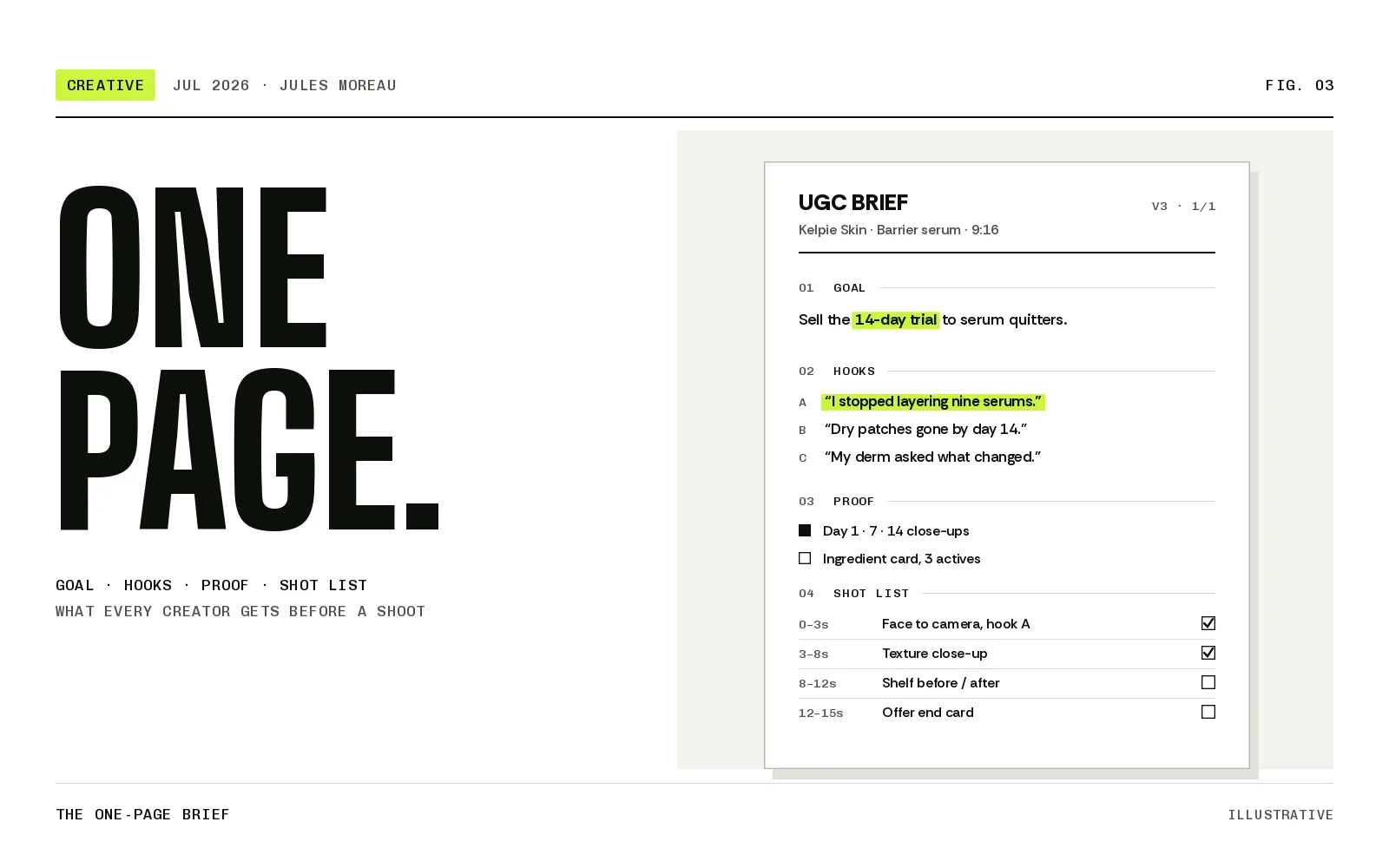
Most UGC that doesn’t work was lost at the brief, not in the edit. Send a creator a mood board and “keep it authentic,” and you’ll get back 45 seconds of someone holding your product and saying they love it. Send them one clear page and you’ll get ads you can test.
Here’s the brief format we use with our creator network.
The one-page structure
Ten fields. If it doesn’t fit on one page, it isn’t clear enough yet.
Goal. One job and one placement. “Stop cold viewers on Reels; judged on hook rate, then CPA.”
Audience. One person in one situation, not a demographic. “Tried five moisturizers this year, and they all sting.”
Single message. The one sentence a viewer should remember. If you have two, you have two briefs.
Hook options. Three to five openings, written out word for word, with the visual.
Proof points. Two or three specific reasons to believe: an ingredient, a number, a guarantee, a review.
Must-say / must-avoid. Claims legal has approved, how to pronounce the brand name, words you can’t use, competitors you won’t mention.
Shot list. Five to seven shots with rough timings.
Format specs. Aspect ratio, length, lighting, audio, and where text and faces must not go.
Deliverables. Body takes, hook takes, raw b-roll, file naming, deadline.
Usage rights. Duration, channels, territories, paid usage, and whether ads run from the creator’s own handle. We default to 12 months.
How to write 3–5 hook variants
The hook is the first one to three seconds: the spoken line, the first frame and the on-screen text together. If it fails, nothing after it gets watched.
Write hooks that use different mechanisms, not synonyms of the same line:
Callout: name the viewer. “If your moisturizer stings, watch this.”
Confession: admit something. “I stopped layering nine serums.”
Result first: open on the outcome. “Day 14. Same cheek. No filter.”
Objection: say the doubt out loud. “I thought barrier cream was just expensive moisturizer.”
Visual demo: no words for the first second, just the product doing its job.
Every hook should lead into the same body, so the creator films the body once and the hooks back to back. One shoot, five ads, and a clean test of which opening works.
How to brief for iterations
When a concept wins, the next brief changes one thing at a time. Otherwise you can’t tell what made the difference.
New hooks on the winning body.
The same script with a different creator.
A different first frame or on-screen headline.
A shorter cut: 15 seconds instead of 30.
Say explicitly what stays locked. Put the learning at the top of the brief: “Hook B (confession) won on hook rate. This round: three more confession hooks.” Creators do better work when they know why they’re shooting.
Common mistakes
Three messages in one video. The viewer remembers none of them.
Scripts that sound read. Give talking points and the exact must-say lines. Let the creator phrase the rest.
No written hooks. Improvised openings are usually the weakest part of the video.
Missing raw files. Ask for clean versions without captions or music, plus b-roll, so the edit team can build iterations without a reshoot.
Rights agreed after the shoot. Settle usage before anyone presses record.
Late product. Ship it early. Nobody films well with a product they opened an hour ago, and results shots need weeks of real use.
Sample brief: Kelpie Skin barrier cream
A short version of a brief for our demo skincare client.
Goal: new-customer purchases from cold traffic on Reels and TikTok. Judged on hook rate first, then CPA.
Audience: late 20s to 30s, dry and reactive skin, has tried several products this year and is tired of stinging and tightness.
Single message: one fragrance-free barrier cream can replace the routine that’s irritating your skin.
Hooks: (A) “I stopped layering nine serums.” (B) “If your moisturizer stings, stop scrolling.” (C) “Day 1 vs. day 14, same light, no filter.” (D) Silent open: cream pressed onto the back of a hand.
Proof points: fragrance-free; 50 ml; first box €29; 14-day money-back guarantee.
Must say: “Kelpie,” “fragrance-free,” “14-day money-back.”
Must avoid: “cure,” “eczema,” “dermatologist-approved,” filters on before-and-after shots, competitor names.
Shot list: hook (0–3 s); shelf of abandoned products (3–6 s); texture on hand (6–10 s); applying to a dry patch in daylight (10–18 s); day-14 close-up in the same light (18–24 s); box and price on screen with CTA (24–30 s).
Specs: 9:16, 25–35 seconds, natural light, clean audio, no music. Keep faces and key text away from the top and bottom edges, where app UI sits.
Deliverables: one body take, four hook takes, 60 seconds of raw b-roll, no burned-in captions. Due 21 days after the product arrives, since the day-14 shot needs two weeks of use.
Usage: paid social, EU and US, 12 months, including ads run from the creator’s handle.
That’s the whole brief. A creator can read it in two minutes, and nothing in it is open to interpretation except the parts you want them to own.
If your UGC gets views but not sales, our Growth Audit includes a teardown of the creative you’re running now.